YunGang Industrial Zone, Yuhuan County, Zhejiang province, China
  +86-18967680938
 Language
 English
 Deutsch
 عربى
عربى



Hitting a punch with a hammer works fine on a workbench. But on a ladder, or in a ceiling, or inside a cabinet — awkward. One hand holds the punch. One hand swings the hammer. No hand left to hold the workpiece or brace yourself. A battery punch driver solves this. It is a cordless tool that drives a punch using an internal spring mechanism or a solenoid. Pull the trigger. The punch fires. No hammer swing. No second hand needed.
How it works
A battery punch driver looks like a thick power tool. Battery pack on the bottom. Barrel on top. Inside, a spring gets compressed by a motor or a solenoid. When the spring releases, it drives a ram forward. The ram hits the back of the punch. The punch tip marks or dimples the workpiece.
The force is adjustable on many models. Low setting for soft materials or shallow marks. High setting for harder steel or deeper dimples. A battery punch driver cannot replace a hammer for heavy center punching on thick plate. But for sheet metal, pipe marking, and layout work, it works well.
Key components
Electrical and plumbing layout
Electricians mark hole locations on junction boxes and panels. Plumbers mark pipe centers for drilling. A battery punch driver puts the mark exactly where needed. No missed strikes. No wandering punch tip.
Sheet metal work
HVAC ductwork and metal stud framing need hole locations marked. A battery punch driver leaves a clear dimple. The drill bit centers in the dimple. Holes end up where they belong.
Automotive and fabrication
Body shops use battery punch driver tools for marking weld locations and panel holes. Fabricators use them for layout on flat stock. The punch mark survives grinding and sanding.
Force range and adjustability
Low-end battery punch driver models have fixed force. One setting. Works for some jobs. Not others. Better models have adjustable force. Dial it down for thin sheet metal. Dial it up for thick plate or hard steel.
Force is measured in joules or newton-meters. More force is not always better. Too much force dents thin material. Too little force leaves no mark on thick material. Adjustability solves this.
Punch tip options
Standard tips are 60-degree and 90-degree cones. 60-degree for general marking. 90-degree for softer materials. A battery punch driver with interchangeable tips covers more applications.
Carbide tips last longer than steel. Hardened steel is fine for occasional use. For daily use in a shop, carbide is worth the extra cost.
Battery compatibility
Most battery punch driver tools use the same battery packs as drills and drivers. Sticking with one battery platform saves money. The tool itself is cheaper without a battery and charger included.
Weak spring or solenoid
Cheap battery punch driver tools do not have enough force for real work. The punch barely marks the surface. You end up hitting it with a hammer anyway. Test before buying if possible.
Poor tip retention
The punch tip needs to stay in the tool. Cheap models have loose retention. The tip falls out between uses. Or worse, the tip flies out when the tool fires. Good models have a positive locking mechanism.
Short battery life
A battery punch driver should run for hundreds of strikes per charge. Cheap models drain batteries quickly. The spring mechanism is inefficient. Solenoid models are better but cost more.
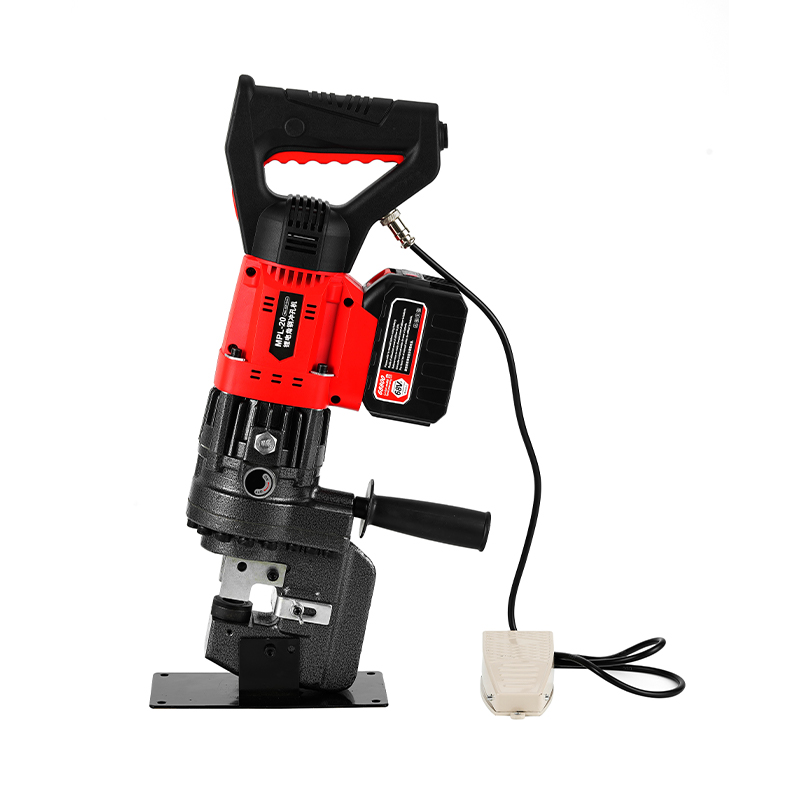
Heavy plate needs a real hammer and punch. A battery punch driver does not have the force for 1/4-inch steel or thicker. It is for sheet metal and light plate. Trying to mark thick material just wears out the tool.
Hardened steel is another problem. Some punches are not hard enough to mark hardened surfaces. The tip blunts or breaks. Know your material before using.
A battery punch driver is a niche tool. Not everyone needs one. But for electricians, plumbers, HVAC technicians, and fabricators who mark holes all day, it saves time and frustration. One hand holds the workpiece. One hand holds the tool. Trigger pull makes the mark. No hammer. No missed strikes. No sore wrist from swinging. When you are on a ladder or in a tight cabinet, that matters.