YunGang Industrial Zone, Yuhuan County, Zhejiang province, China
  +86-18967680938
 Language
 English
 Deutsch
 عربى
عربى
Home / News / Industry News / Why Is Copper Bar Processing Equipment Becoming Central to Industrial Workshops?




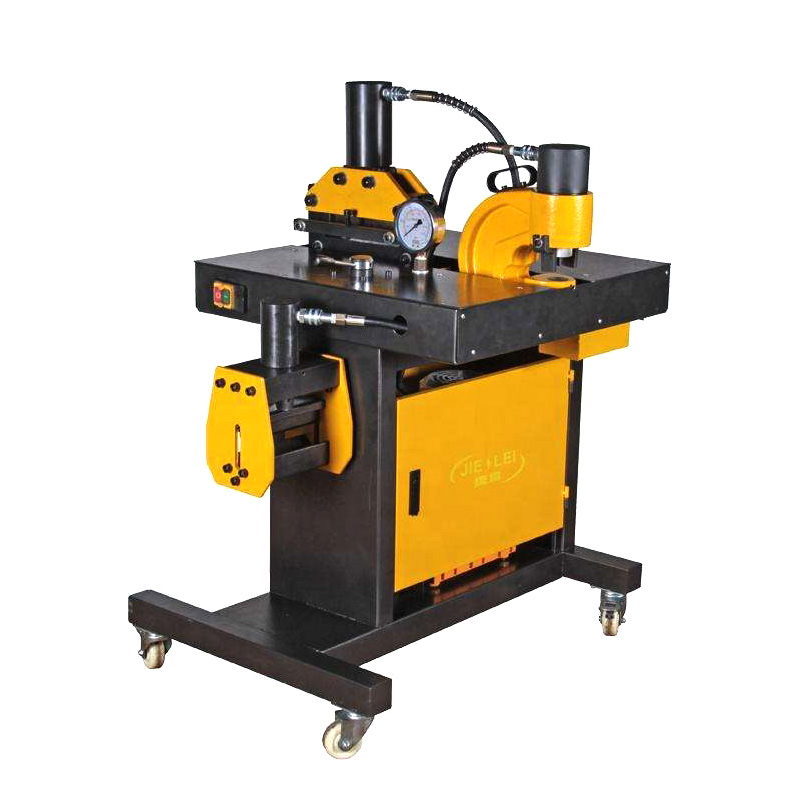
In the world of electrical manufacturing, reliability often depends on details that remain unseen. Behind switchgear cabinets, control panels, and distribution systems, copper bars quietly carry large currents across complex networks. Shaping these conductors into accurate forms requires more than manual skill. It calls for well-designed Copper Bar Processing Equipment that can cut, bend, and punch with consistency.
While it may not attract attention like finished electrical products, this equipment plays a vital role in shaping how infrastructure is built and maintained.
Copper bars must meet strict dimensional requirements. Even minor deviations can affect installation, alignment, and electrical contact. Traditional manual processing methods often relied heavily on operator experience, making consistency difficult when volumes increased.
Modern Copper Bar Processing Equipment brings repeatability into the process. Programmable controls allow operators to set cutting lengths, bending angles, and punching positions with clarity. Once parameters are entered, the machine reproduces them across multiple pieces, reducing variation between batches.
This consistency helps downstream assembly teams work more efficiently. When copper bars fit as expected, panel assembly becomes smoother and adjustments on site are reduced.
Processing copper manually can be time-consuming and physically demanding. Cutting thick bars or bending them into precise shapes requires significant force and careful measurement. As production demands grow, relying solely on manual labor becomes less practical.
By integrating Copper Bar Processing Equipment into workshops, manufacturers can reorganize their workflows. A single system may handle cutting, bending, and punching in one coordinated process. This reduces the need to move materials between separate stations, saving time and lowering the risk of handling damage.
At the same time, operators can focus more on monitoring quality and less on repetitive heavy tasks. This shift not only improves efficiency but also supports safer working conditions.
Electrical installations vary widely depending on building size, voltage requirements, and layout constraints. As projects become more customized, copper bars often need unique shapes and hole patterns.
Copper Bar Processing Equipment with flexible settings allows manufacturers to respond to these changing requirements without extensive retooling. Adjustments can be made through digital interfaces rather than physical modifications to machinery. This flexibility is valuable when handling smaller batch sizes or special orders.
In this way, equipment does more than shape metal—it supports adaptability in project design.
In power systems, reliability is critical. A poorly processed copper bar can create resistance, heat buildup, or mechanical instability. To reduce such risks, manufacturers increasingly rely on documentation and traceability.
Modern Copper Bar Processing Equipment often includes data recording functions. Cutting dimensions, bending angles, and production times can be logged for review. If an issue arises later, teams can trace it back to specific production parameters.
This approach strengthens quality management. Instead of depending solely on visual inspection, companies can use stored data to analyze patterns and refine their processes.
Copper is a valuable material, and efficient use is essential. Accurate cutting reduces scrap, while precise punching lowers the chance of rejected components. Over time, small savings in material usage can have a noticeable impact on overall costs.
Some Copper Bar Processing Equipment models also focus on energy-efficient operation. Hydraulic systems, motor controls, and automated shutdown features help reduce unnecessary power consumption during idle periods.
While these improvements may seem incremental, they reflect a broader effort within manufacturing to balance productivity with responsible resource management.
When people think about power distribution, they picture transformers, cables, and circuit breakers. Rarely do they consider the machines that shape the conductors connecting these elements. Yet without reliable Copper Bar Processing Equipment, the assembly of electrical systems would be far less consistent.
By improving precision, supporting customization, enhancing safety, and contributing to quality control, this equipment has become a foundational part of modern workshops. It may operate behind the scenes, but its influence reaches into buildings, factories, and infrastructure projects around the world.
So perhaps the real question is not whether Copper Bar Processing Equipment matters, but how much of today's reliable electrical network depends on its steady, accurate performance.